DepartUK › Guides › How UK Train Delays Are Measured (And Why 'On Time' Doesn't Feel On Time)
How UK Train Delays Are Measured (And Why 'On Time' Doesn't Feel On Time)
How UK Train Delays Are Actually Measured
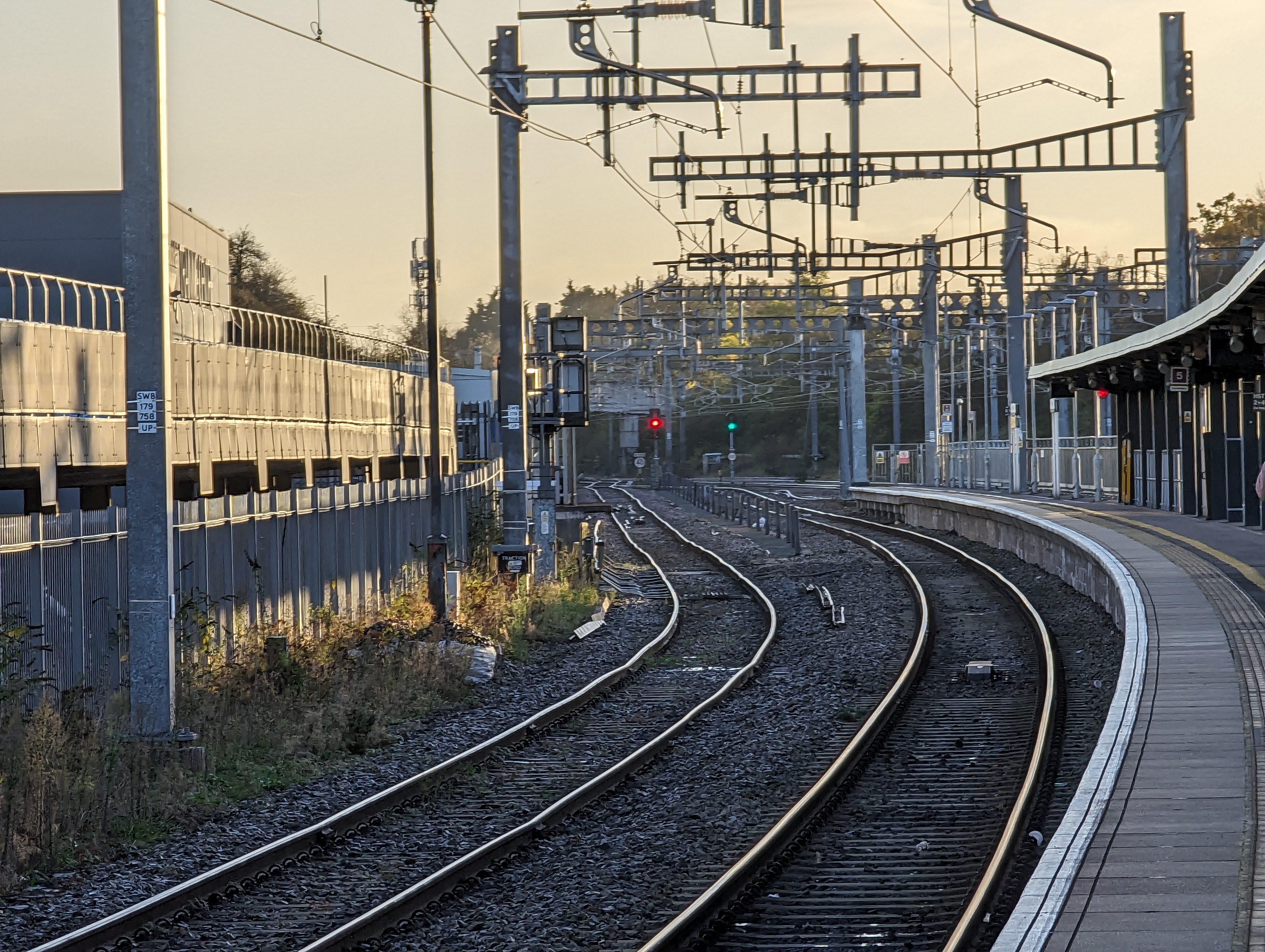
It is a scene familiar to anyone who travels by train across Britain. Your train comes to a dead stop in a cutting outside your destination. You spend ten minutes staring at trackside weeds while the clock on your phone ticks forward. Finally, the brakes release, the train rolls into the platform, and a cheerful automated voice chimes: "We are pleased to announce that this train has arrived on time."
If you have ever rolled your eyes at that announcement, you are not alone. There has always been a noticeable gap between what passengers experience on the ground and what train operators record on their performance charts.
So how are UK train delays actually measured, and why do official punctuality numbers often feel disconnected from reality?
The old benchmark: The five-minute grace period
For decades, the headline measure of UK train punctuality was the Public Performance Measure (PPM). Under PPM, a train was counted as "on time" if it arrived within five minutes of schedule for commuter and regional routes, or within ten minutes for long-distance services heading to hubs like York or Manchester Piccadilly.
To passengers, this definition always felt remarkably generous. Turn up four minutes late for a job interview and nobody praises your punctuality. Yet on the railway, a service arriving 4 minutes and 59 seconds late was chalked up as a 100% on-time arrival.
Worse still, PPM only measured the final destination. A train from Bristol Temple Meads to London Paddington could run 15 minutes late through Reading, causing headaches for commuters along the line. But if the driver made up time before London, the entire service went down in the record books as punctual.
The modern standard: "On Time" at every stop
To fix this perception gap, the rail industry and the Office of Rail and Road (ORR) overhauled punctuality reporting in 2019.
The headline modern metric is simply called "On Time". Under this standard, a train is recorded as on time only if it arrives within 59 seconds of schedule—effectively right to the minute.
Crucially, modern metrics record arrivals at every single timetabled station call along the route, not just the final stop. Alongside "On Time", the industry also tracks "Time to 3" (within three minutes) and "Time to 15" (within fifteen minutes).
This was a major improvement. It stopped operators from hiding mid-route delays behind a fast finish. Even so, passengers still regularly experience journeys that feel late even when the timetable says otherwise.
The secret ingredient: Timetable padding
The main reason a train can crawl outside London Waterloo or London Euston and still claim an on-time arrival comes down to recovery time—commonly known as timetable padding.
Timetable planners know real-world journeys rarely run with mathematical perfection. Passengers take longer to board with luggage, signals turn yellow, or temporary speed restrictions crop up.
To prevent minor hold-ups from cascading across the network, planners insert buffer minutes into schedules. This padding is usually concentrated on approaches into major bottlenecks like Birmingham New Street, Clapham Junction, or Leeds.
A journey that physically takes 25 minutes might have 30 minutes timetabled. If everything goes smoothly, your train simply rolls in a few minutes early. But if it gets held outside the station, those spare minutes absorb the delay. You spent five minutes sitting motionless, but by the timetable clock, you arrived right on time.
The connection trap
While railway statistics measure delays in minutes, passengers feel them in missed connections.
If an incoming train reaches a junction like Crewe or Peterborough three minutes late, the railway treats that as a minor variance—well within "Time to 3". But if you had a tight five-minute transfer to an hourly service, three minutes is all it takes to watch your connecting train pull away.
On the operator's scorecard, that first train performed well. For you, your journey time just doubled, leaving you stranded on a draughty platform.
Punctuality versus Delay Repay
It is also easy to confuse punctuality statistics with compensation.
An officially delayed train does not automatically entitle you to a refund. Most operators use Delay Repay 15 (or Delay Repay 30), which only pays out if your journey is delayed by at least 15 or 30 minutes against your scheduled arrival at your final ticketed destination.
If a train arrives 12 minutes late, it is recorded as late in industry stats, but falls squarely into the gap where no compensation is due.
Knowing what is really happening
Understanding these mechanics makes live departure boards much easier to interpret. Modern metrics are far more realistic than the old PPM standard, but timetables will always rely on recovery padding and built-in margins.
When booking journeys with connections, always give yourself a comfortable buffer above the official minimum transfer time at busy hubs, and follow live departure updates rather than printed timetables. That way, when the automated announcer thanks you for your patience, you will know exactly how the clock was managed.